Leleg Way: Bodrum’s Ancient Hiking TrailAn 88 km main route from Etrim to Turgutreis: Pedasa, the Leleges, route, duration, walking tips and history
Leleg Way is a long-distance hiking trail that links the inland side of the Bodrum Peninsula: the ancient Lelegian towns on the hills, pine forests and villages. It takes its name from the Leleges, one of the oldest peoples of the peninsula.
The main route starts in the village of Etrim, ends at Sabancı Park in Turgutreis and is 88 kilometres long; with its link paths the total length reaches 185 kilometres. In this guide we cover the route, the Leleges, Pedasa and what you need to know before you walk.
- Main route
- 88 km, Etrim → Turgutreis
- Total
- 185 km with link paths
- Duration
- About 5 days of walking
- Opened
- First stage March 2016
Leleg Way photos
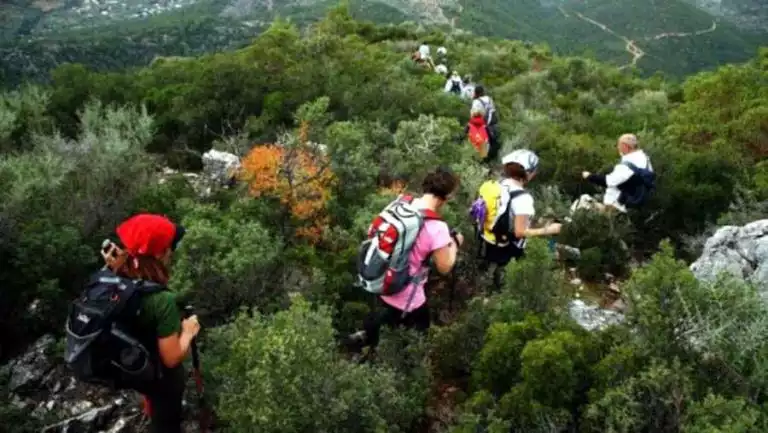 1 / 6
What is the Leleg Way?
The route was created through the “Bodrum Leleg Way” project prepared by the Bodrum Chamber of Commerce and supported by the South Aegean Development Agency (GEKA) under its 2015 Alternative Tourism Infrastructure Financial Support Programme. The project covers hiking paths, cycle paths and landscaping.
The aim was to promote Bodrum not only with sea, sand and sun but also with nature, history and culture, and to spread the tourist season over a longer part of the year. The first stage was opened in March 2016 with a ceremony at the foot of Pedasa Castle in Konacık.
- Main route: 88 km, between Etrim village and Sabancı Park in Turgutreis.
- Total length: 185 km with link paths.
- Duration: The whole Leleg Way takes about 5 days to walk; it cannot be done in a single day.
- Cycling: Part of the Leleg Way has a mountain bike trail.
- Stops: Ancient towns, historic water cisterns, a church, a cave and villages.
Leleg Way route
The Leleg Way starts in Etrim in the east of the peninsula and runs west along the ridges to Turgutreis. The paths mostly cross mountain slopes, valleys and pine forests; in most places you cannot continue by car.
- Etrim: The starting point of the main route; a village in the east of the peninsula.
- Pedasa and Konacık: Pedasa Castle, where the opening ceremony was held, stands on the wooded hills above Konacık. After Pedasa, the first stage continues to Çukursarnıç, Konacık and Dağbelen.
- Gebe Kilise: A tumulus visited on walks between Yokuşbaşı and Pedasa; it can be added to the route via the link paths.
- Sabancı Park, Turgutreis: The end point of the main route; the park next to the marina.
For stage-by-stage details, a map and route information, see the GoTürkiye route page. Before you set off, also ask about the current state of the trail; signs and paths can deteriorate over time in some sections.
If you want to walk the Leleg Way stage by stage, one of the easiest starting points is the Konacık and Pedasa area; it is close to Bodrum town and suits a half-day walk. For the longer stages you may need to arrange a car or taxi between the start and end points. When passing through villages, take care of local people’s fields and gardens.
Who were the Leleges?
The Leleges are one of the oldest peoples of Western Anatolia. According to Herodotus’ sources, the Leleges lived in this region, centred on the Bodrum Peninsula, between the 15th and 4th centuries BC. Most of what we know about them is based on the accounts of ancient writers, above all Herodotus of Halicarnassus.
Herodotus writes that the Carians were formerly called Leleges; in ancient sources the Leleges appear as the ancestors of the Carians. They built their settlements on hard-to-reach hills and slopes as protection against pirate raids. This choice gave them both an easy defence and a view over the sea and the islands.
The most striking feature of the Lelegian settlements is their walls and buildings made of large stones stacked without mortar. Some of these dry stone walls can still be seen along the paths.
The Leleg Way and the Lelegian towns of the Bodrum Peninsula
Ancient writers mention eight towns founded by the Leleges on the Bodrum Peninsula; the names vary slightly from source to source. The Leleg Way crosses the hills that link some of these settlements.
- Pedasa: Above Konacık, the best preserved Lelegian town.
- Theangela (Syangela): Near Etrim, a town refounded in the time of Mausolus.
- Termera: A Lelegian town on the ridges facing Aspat.
- Telmissos, Madnasa, Uranion and Side: Other Lelegian towns named in the sources; the location of some is still debated.
Pedasa ancient city: the heart of the Leleg Way
Pedasa lies about 6 kilometres north of Bodrum town, at Gökçeler in Konacık. Locals also call it “Gökçeler Castle”. The town is thought to have been founded in the transition from the Late Bronze Age to the Early Iron Age, about three thousand years ago.
Excavations led by Prof. Dr. Adnan Diler of Muğla Sıtkı Koçman University located the site of a 6th-century BC Temple of Athena. With its platform tombs and inner citadel, Pedasa is one of the most visited points on the route. The opening ceremony of the first stage was also held at the foot of Pedasa Castle.
Mausolus and the abandonment of the Lelegian towns
Mausolus, who ruled Caria in the 4th century BC, moved the capital to Halicarnassus and began a large building programme to turn the city into a powerful port. The Mausoleum at Halicarnassus built in his name was counted among the seven wonders of the ancient world.
During this period most of the people of the Lelegian towns on the peninsula were resettled in Halicarnassus. The hilltop settlements gradually emptied; the stone walls you see along the paths today are silent witnesses of this change.
Leleg Way timeline
- Leleges
According to Herodotus’ sources, the Leleges begin to live in this region centred on the Bodrum Peninsula.
- Temple of Athena at Pedasa
The temple, whose site was located in excavations, becomes one of the most important sanctuaries of the peninsula.
- Mausolus era
The people of the Lelegian towns move to Halicarnassus; the hilltop settlements begin to empty.
- Project support
The Bodrum Chamber of Commerce project receives support from GEKA’s Alternative Tourism Infrastructure programme.
- First stage opens
Completed in three months, the first stage opens at the foot of Pedasa Castle in Konacık.
- Promotion
The route begins to be promoted to agencies as a nature and alternative tourism route.
Walking tips for the Leleg Way
- Carry plenty of water; there is not water everywhere
- Wear hiking boots that support your ankles
- Download the route to your phone and carry a charger
- Do not walk in the midday summer heat
- Take a hat and sunscreen
- Tell someone your route
- Walk in a group, not alone
- Do not step on ancient stones or take any away
Summers in Bodrum are very hot, so the most comfortable seasons for walking are spring and autumn. Guided hiking groups and local nature walking clubs also organise stage walks on the Leleg Way from time to time. If you want to cycle, it is worth having your bike checked at a bike repair shop in Bodrum before you go.
Leleg Way: a heritage to protect
The ancient towns and walls on the Leleg Way are part of a heritage thousands of years old. Construction, road works and stones moved by visitors can cause irreversible damage to these sites. The care of walkers matters as much as excavations in passing this heritage on to future generations.
Stay on the path, do not climb the walls and take your rubbish back with you. Follow the instructions of staff at excavation sites. For Bodrum’s other ancient settlements, see our Bodrum ancient cities guide.
In Bodrum there is a saying attributed to the Fisherman of Halicarnassus: “Don’t think you will leave the way you came.” For those who walk the Leleg Way for a few days, the saying suits Bodrum’s hills even more than its coast.
Leleg Way frequently asked questions
Where does the Leleg Way start and end?
The main route starts in the village of Etrim in the east of the Bodrum Peninsula and ends at Sabancı Park in Turgutreis.
How long is the Leleg Way?
The main route is 88 kilometres. Including the link paths, the total length reaches 185 kilometres.
How many days does it take to walk the Leleg Way?
The whole route takes about 5 days. It cannot be walked in a single day; most people complete it stage by stage with day walks.
When did the Leleg Way open?
Prepared through a GEKA-supported project of the Bodrum Chamber of Commerce, the first stage of the trail opened in March 2016 at the foot of Pedasa Castle in Konacık.
Where does the trail get its name?
From the Leleges, one of the oldest peoples of the Bodrum Peninsula, who built towns on the hills with dry stone walls.
Can you cycle the route?
Yes. Part of the route has a mountain bike trail, but most paths are steep and rocky and need mountain biking experience.
What is the best season to walk this route?
Spring and autumn. In summer there is little shade on the hills and the heat is high; if you walk in summer, choose the early morning hours.
Where is Pedasa ancient city?
About 6 kilometres north of Bodrum town, at Gökçeler in Konacık. Locals also call it Gökçeler Castle.
What can you see on the Leleg Way?
Ancient Lelegian towns and dry stone walls, Pedasa, historic water cisterns, a church and caves, the Gebe Kilise tumulus, olive groves, pine forests and villages.
When did the Leleges live?
According to Herodotus’ sources, the Leleges lived in this region, centred on the Bodrum Peninsula, between the 15th and 4th centuries BC.
Should you walk the route with a guide?
It is not required, but the signs can be weak in some sections. If you are walking for the first time, go with a guided group or download the route to your phone.
Can you find water and food along the way?
You can in the sections that pass through villages, but on the ridges there may be nothing for long stretches. Take plenty of water and snacks.