Theangela Ancient City BodrumThe Carian city Mausolus refounded on Kale Dağı above Etrim: history, remains, the Lelegian Way and visiting
Theangela is a Carian city on Kale Dağı, just above Etrim in the east of the Bodrum Peninsula. In the 4th century BC, the Carian satrap Mausolus moved the people of the old Lelegian city of Syangela to this hill, and the city became Theangela.
Today you can see walls, towers, cisterns and the remains of a small stadium spread over three hilltops. It is not an excavated, landscaped archaeological site but a quiet, scenic one that you reach on foot. This guide covers the city’s history, its remains, its link with the Lelegian Way and visitor information, with sources.
- Founded
- 4th century BC, under Mausolus
- Earlier city
- Syangela (Lelegian city)
- Location
- Above Etrim, Kale Dağı (538 m)
- Today
- Remains of walls, towers and buildings
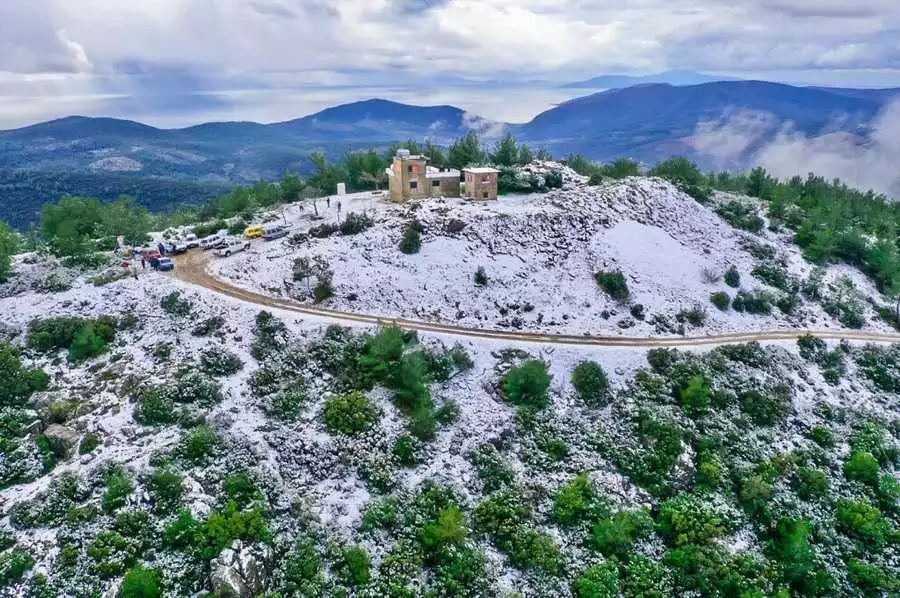
A view from Kale Dağı
History of Theangela
The story begins with Syangela. Syangela was one of the Lelegian cities of the peninsula and appeared in the tribute lists of the Athenian-led Delian League in the 5th century BC. The name of Pigres, a local ruler of that time, is also associated with this city.
Mausolus, who ruled Caria from 377 to 353 BC, moved his capital from Mylasa (Milas) to Halicarnassus and settled the people of most of the peninsula’s Lelegian cities in the new capital. According to the ancient geographer Strabo, two of the eight Lelegian cities, Syangela and Myndos, were left out of this merger. Instead of closing Syangela, Mausolus moved it to a higher hill nearby and enlarged it; the new city was named Theangela.
When Alexander the Great took Caria in 334 BC, he placed the city under the control of Halicarnassus, according to Pliny. The 4th-century BC historian Philip of Theangela was born here; later writers quote what he wrote about the Carians and the Leleges.
The most famous document from the city is a treaty inscription dated to the late 4th or early 3rd century BC. It describes the agreement that the Macedonian general Eupolemus made with the city he besieged and with the mercenaries inside it, including details such as paying the soldiers four months’ wages. The French epigraphist Louis Robert also noted that the city was famous for its honey and that this honey was sent to Egypt.
Timeline: from Syangela to today
- Syangela and Pigres
The Lelegian city of Syangela appears in the Delian League tribute lists; Pigres is the local ruler of the area.
- Mausolus’ new city
The people of Syangela move to Kale Dağı, and the city takes its new name.
- Alexander the Great
The city is placed under the control of Halicarnassus.
- The Eupolemus treaty
After the siege, a written treaty is made between the city, Eupolemus and the mercenaries.
- Honey for Egypt
According to Louis Robert, the city’s honey goes to Ptolemaic Egypt.
- Scholarly research
George Bean and John Cook document the city’s plan and remains in their study of the peninsula.
- A stop on the Lelegian Way
The site is one of the stops on the walking routes that start from Etrim.
Where is Theangela?
The ancient city is on Kale Dağı, which rises just south of Etrim, a village of Pınarlıbelen, about 14 km east-northeast of Bodrum centre. The hill is 538 metres high; as one of the highest points of the peninsula, its summit gets snow in some winters.
There is no road to the top; you first drive to Etrim and then walk up a footpath. For more about Etrim, see our Etrim village tour guide; Etrim is a village of Pınarlıbelen.
What to see at Theangela Ancient City
According to George Bean’s description, the city has a long, narrow plan: it stretches about 1,300 metres from east to west, with an average width of 250 metres. The main remains:
- City wall: The wall that encircles the whole city can still be traced from end to end. The south side is reinforced with rectangular towers, and the main gate is on this side.
- Three separately fortified hilltops: Each of the three summits the city spreads over has its own wall; one of them holds the acropolis.
- Cross wall: A wall separates the western and eastern parts. Almost all the buildings are in the eastern part; according to Bean, the city was reduced by more than half because not enough people could be settled in the new city. A similar situation is seen at Halicarnassus and Myndos.
- Four-towered fort: A fort with four towers adjoining the wall; forts of this kind are considered typical of Caria.
- Stadium and palaestra: The remains of a small stadium and a Hellenistic palaestra (exercise ground) in the eastern part.
- Temple, houses and cisterns: A temple, a Lelegian-type house and cisterns that met the city’s water needs.
- Chamber tomb: A chamber tomb on the slope of the eastern hill, attributed to the 5th-century ruler Pigres.
Fragments of archaic sculpture found on the site suggest that a sanctuary of Syangela may have been here. For a detailed list of the remains and their coordinates, see the Pleiades ancient places entry.
Theangela and the Lelegian Way
The 88-kilometre main route of the Lelegian Way starts in Etrim and runs to Turgutreis, so the ancient city counts as the first major historical stop at the eastern end of the route. Walking groups record the first stage from Etrim up to Theangela as about 11 km long with close to 500 metres of climbing; a walk of moderate difficulty.
If you are curious about the peninsula’s other Lelegian cities, our Bodrum ancient cities guide is a good start.
Common mistakes about Theangela
Conflicting information about this ancient city circulates online. Common claims and the facts:
| Mistake | Fact |
|---|---|
| The city was founded in the 5th century BC | The city that goes back to the 5th century is Syangela. Today’s remains belong to the new city Mausolus founded in the 4th century. |
| The city kept its importance while Mausolus emptied the peninsula | The city is itself a product of that process: instead of closing Syangela, Mausolus moved it here. |
| The city was founded by “Mausolus II” | The founder is Mausolus, son of Hecatomnus; the title “II” does not appear in the sources. |
| Its name is Thaengela or Tyangela | The correct spelling is Theangela (Greek Θεάγγελα). |
How to visit Theangela Ancient City
- Starting point: Etrim. The path from the village to the hilltop is steep and the walk takes time; if you are going for the first time, asking for directions in the village or going with a guide makes things easier. Open in Maps
- Entry: The sources mention no ticket office or marked visitor path; the site is on open land.
- When to go: Spring and autumn are best. In summer the slopes are shadeless and very hot; set off early in the morning.
- Bring: Plenty of water, closed non-slip shoes and a hat. Water and food are hard to find on the way.
- Rules: This is a protected archaeological site; do not remove stones, climb the walls or light fires.
- Nearby: The carpet workshops in Etrim and Mumcular.
Theangela FAQ
Where is Theangela?
In the east of the Bodrum Peninsula, on the 538-metre Kale Dağı just south of Etrim, a village of Pınarlıbelen. It is about 14 km from Bodrum centre.
Who founded Theangela?
In the 4th century BC, the Carian satrap Mausolus moved the people of the old Lelegian city of Syangela to this hill, and the city was named Theangela.
Is Syangela the same place as this city?
No. Syangela is the older Lelegian city and lies on another hill nearby. The city on Kale Dağı is the new city to which Mausolus moved its people, which is why the two names are often mentioned together.
What can be seen in the city?
A city wall that can be traced from end to end, the towers and main gate on the south side, three separately fortified hilltops, a four-towered fort, a small stadium, a palaestra, a temple, cisterns and a chamber tomb.
How do you get to the ancient city?
First go to Etrim, then walk up to the hilltop on a footpath. The path is steep; if you are going for the first time, asking for directions in the village or going with a guide makes things easier.
How long does the walk take?
Walking groups record the Etrim–Theangela stage as about 11 km with close to 500 metres of climbing; allow a few hours including breaks. A short walk up and down takes less time.
Is there an entrance fee?
The sources mention no ticket office or marked visitor path; the site is on open land. Still, remember that it is a protected archaeological site.
Is Theangela on the Lelegian Way?
The main route of the Lelegian Way starts in Etrim, and Theangela counts as the first major historical stop at the eastern end of the route.
What is the best season to visit?
Spring and autumn. In summer the slopes are shadeless and very hot; in winter the summit sometimes gets snow.
Was anyone famous born in the city?
Yes. The 4th-century BC historian Philip of Theangela was born here; later writers quote what he wrote about the Carians and the Leleges.
What is the Eupolemus treaty?
An inscription describing the treaty that the Macedonian general Eupolemus made with the city he besieged and with the mercenaries in it. It dates to the late 4th or early 3rd century BC.
What else is nearby?
The carpet workshops in Etrim, the villages of Mumcular and Karaova, and the stages of the Lelegian Way that continue westwards.