Türkbükü History and Rock-cut TombsA visitor guide to ancient Madnasa and its Lelegian traces
Türkbükü history starts on the ridges above a bay that is known today for its jetties and beaches. A line of research led by G. E. Bean identifies the remains on the hill overlooking Gölköy and Türkbükü with Madnasa, a town of ancient Caria. A defensive wall, a tower, cisterns, house foundations and tombs cut into the rock are the features most often mentioned for this settlement.
This guide sets out what the sources say about Türkbükü history and where they disagree. You will also find rules for visiting, nearby historical stops and current public transport information.
- Ancient settlement
- Madnasa (Medmasa), Caria
- Written record
- Athenian tribute lists, 5th century BC
- Public transport
- MUTTAŞ line 2-46 Bodrum–Göltürkbükü
Photos of Türkbükü and Its Surroundings
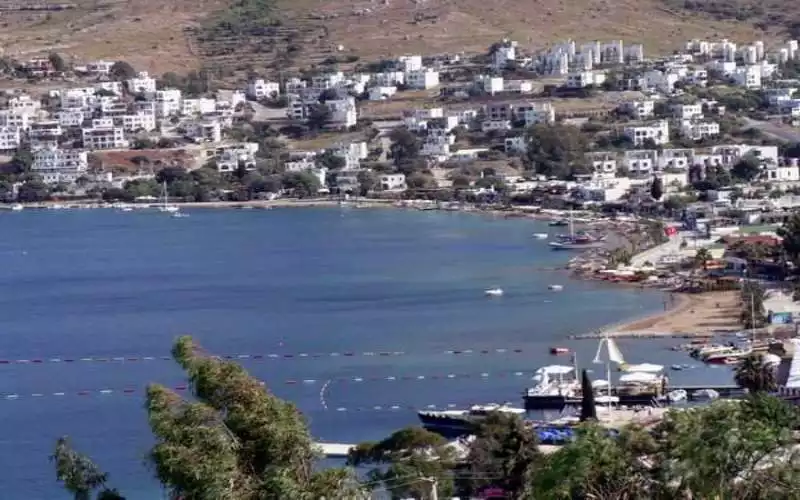
Türkbükü History: What Do the Sources Say?
In ancient texts and modern research the town appears as Madnasa, Medmasa or Medmasos. Fragments of Hecataeus quoted by the ancient lexicographer Stephanus of Byzantium point to an earlier name, Kurbasa. The Roman writer Pliny also mentions the settlement in the fifth book of his Natural History. A summary of the names and dates is available in the Wikipedia article on Madnasa.
Iron Age: a hilltop settlement facing the bay
The archaeological atlas Vici.org describes Madnasa as a hilltop settlement going back to the Early Iron Age and compares it with Pedasa and Termera. Its position looking down on Türkbükü Bay is one of the most tangible foundations of any account of Türkbükü history.
5th century BC: the Athenian tribute lists
Madnasa appears among the paying members of the Delian League in lists kept at Athens. Potsherds (ostraka) identified at the site date to the 5th century and the early 4th century BC. These data make the Classical period a documented stage of Türkbükü history.
4th century BC: joining Halicarnassus
The geographer Strabo reports that Mausolus united six of the eight Lelegian towns into Halicarnassus and left Syangela and Myndus as they were. Pliny writes that six settlements, Medmasa among them, were attached to Halicarnassus, but credits the arrangement to Alexander the Great. Keep this difference in mind when reading about Türkbükü history.
19th and 20th centuries: modern research
One of the first modern records of the area is the 1894 study of Carian sites by Paton, Myres and Hicks. In their survey of the Halicarnassus peninsula, published in 1955, G. E. Bean and J. M. Cook linked the visible remains on the hill with Madnasa.
The date of “2000 BC” that appears in some accounts has not been confirmed by excavation for Türkbükü. Bronze Age Mycenaean tombs on the peninsula are documented at Müsgebi, near present-day Ortakent, and the finds are kept in Bodrum Castle (Halicarnassus article). Those discoveries should not be confused with Türkbükü history. For more on the area, see our Göltürkbükü guides.
The Remains of Madnasa and the Türkbükü Rock-cut Tombs
The most concrete evidence for Türkbükü history is the structures visible on the surface. According to published research summaries, the settlement stretches along a long, narrow hilltop, where traces connected with defence, water storage, housing and burial lie close together.
- Defensive wall: A wall of polygonal masonry encloses an area of about 300 × 90 metres. This measurement describes the walled core, not the whole of the town’s ancient territory.
- Tower: A tower built of dressed stone blocks stands at the highest point. Its position suggests a good lookout over the surroundings.
- Cisterns and house foundations: Research records mention cisterns and numerous house foundations. Storing water was a basic need of daily life in a hilltop settlement.
- Rock-cut tombs: A group of tombs is cut into the rock face at the western end of the settlement. This is the basic, sourced fact about rock tombs in Türkbükü history.
- Surface finds: For Türkbükü history, potsherds are among the dating evidence showing that the site was used in the Classical period. They should be left where they are found.
Travel sources state that no extensive excavation has been carried out. It is therefore not possible to speak with certainty about the interior layout of the tombs, who was buried in them or their individual dates. Do not treat generalisations such as “single-chambered”, “with sarcophagus platforms” or “with offering niches” as established fact unless a published study is cited.
The coordinates given for Madnasa in online archaeological atlases do not match exactly. Rather than relying on a single map pin, confirm the location with someone who knows the area, or with museum staff in Bodrum, before you set off. That way your exploration of Türkbükü history will not end on private land or a dead-end path.
Who Were the Lelegians? Their Place in Türkbükü History
The Muğla Provincial Directorate of Culture and Tourism, reports that ancient sources regard the Lelegians as ancestors of the Carians, that they founded eight towns on the Bodrum Peninsula and that Pedasa was the most important. Strabo writes that Lelegian tombs, fortifications and traces of settlement could be seen across Caria and around Miletus. In writing on Türkbükü history, research tradition counts Madnasa among these Lelegian towns.
Tomb types documented at Pedasa
Excavation and conservation work led by Professor Adnan Diler at Pedasa from 2007 identified round stone tumuli, cist graves and platform tombs, which mostly held cremation burials. This information relates to Pedasa; it would be wrong to assign the same features directly to the rock tombs at Madnasa.
Türkbükü history and the current academic debate
In an article by Jana Mokrišová of the University of Cambridge, published in Anatolian Studies in 2023, this study of the Lelegians argues that no separate material culture specific to the Lelegians can be distinguished in the first millennium BC and that Lelegian identity was shaped in later centuries. According to the author, platform tombs are unique to the peninsula but occur alongside more widespread tomb types.
The Carian and Halicarnassian connection
Madnasa was part of the network of coastal settlements in ancient Caria. The rise of Halicarnassus as a major centre of government in the 4th century BC affected the population and political standing of the small towns around it. When Madnasa was fully abandoned remains a question in Türkbükü history that needs its own evidence.
For this reason, the most balanced approach to Türkbükü history is to read “Lelegian settlement” as the testimony of ancient authors and the interpretation of researchers. Linking a structure to a single people on the basis of tomb form requires excavation context and expert study.
Visiting and Conservation Rules
The sources used for this guide give no announced ticket office, opening hours or marked visitor route for Madnasa. Before going to look for traces of Türkbükü history, ask whether the area is accessible and whether the way there crosses private property.
- No unauthorised digging or collecting: Do not search for treasure, dig, remove stones or collect pottery. Even a small fragment carries dating information where it lies.
- Duty to report: Law No. 2863 (Article 4) requires anyone who finds cultural property to notify the nearest museum directorate, the village headman or the local civil authority within three days.
- Respect the tombs: Do not enter the cavities, leave writing or marks on the rock, climb on the structures or light fires.
- Private property and safety: Do not force closed gates or barriers. Keep away from building sites, loose walls, cistern openings and cliff edges.
- Preparation: Wear closed shoes with non-slip soles and bring enough water and a hat. Avoid the midday heat in summer, and if you go alone, share your location with someone close to you.
- Guided visit: A guide who knows Türkbükü history and archaeology can help you recognise traces of walls, terraces and tombs. Ask about the guide’s licence and the route in advance.
Pros and Things to Watch Out For
For anyone interested in Türkbükü history, this route adds a different layer to a seaside holiday, although it may need more preparation than a visit to a managed archaeological site.
Advantages of a Türkbükü history visit
- It lets you think about the traces of an ancient settlement on the spot, on a hill above the bay.
- Different kinds of remains, including a wall, tower, cisterns, house foundations and rock tombs, are associated with the same settlement.
- It can be planned together with beach time, a museum visit and other ancient stops on the peninsula.
- It sets the link between Caria, Halicarnassus and Türkbükü history in a real landscape.
Cautions for a Türkbükü history visit
- Because no visitor arrangements have been published, access needs to be confirmed in advance.
- Map coordinates can differ from one source to another.
- The sloping, rocky ground may be difficult for young children and people with limited mobility.
- Some remains linked to Türkbükü history may be hard to recognise without expert help.
Things to Do Nearby
You do not have to squeeze a Türkbükü history trip into a single day. The stops below help place Madnasa within the wider past of the peninsula. For more options, use our guide to places to visit in Bodrum.
Pedasa Ancient City
Pedasa, according to the provincial directorate, lies about 6 km north of central Bodrum and about 2 km from Konacık. It states that you can drive as far as the Sanctuary of Athena and that walking routes have been created. Its Google rating is 4.3 from 413 reviews.
Bodrum Castle and Museum of Underwater Archaeology
The museum inside the castle (Kale Cd., Çarşı) is a strong choice for seeing finds from around the peninsula and from under the sea. Telephone: 0252 316 25 16. Check ticket office hours and any closed sections before you go.
Mausoleum of Halicarnassus and Ancient Theatre
The remains of the Mausoleum and the ancient theatre help you grasp the scale of Halicarnassus, the city to which Madnasa was attached. If you plan both for the same day, check current opening hours.
A break on the shore after exploring Türkbükü history
After a hill walk you can rest by the bay. At beach and jetty businesses, ask about entry, sun lounger and spending conditions before you sit down.
How to Get to Türkbükü
The village that serves as the starting point for a Türkbükü history route is on the north coast of the Bodrum Peninsula. You may need local advice for the final stretch to the historical area; the information below covers travel to the village.
- Public transport: According to the timetable on the MUTTAŞ page for line 2-46 Bodrum–Göltürkbükü, dated 27 November 2026, on weekdays, Saturdays and Sundays the first bus leaves Bodrum at 07:40 and the last at 22:30. From Göltürkbükü the first departure is at 07:00 and the last at 21:30.
- Check the service: Times can change with the season, weather and traffic. Some services also call at Torba bus station, so open the current timetable before you travel. The MUTTAŞ page states that you can pay by credit card on board.
- Private car: Set your satnav to Türkbükü. Journey time varies with traffic and season; allow time to find parking, especially on summer days.
- From the airport: From Milas–Bodrum Airport you can take the Havaş or MUTTAŞ service to Bodrum and change to the local line, or compare taxi and transfer options.
Ratings and Reviews
No separate rating for Madnasa as an archaeological site appears in a Google Maps search, so none is given. Below are the Google ratings, as of 27 November 2026, for three widely reviewed historical stops that you can combine with your Türkbükü history trip.
What reviewers like
At the museum, the castle walls, sea views and rich collection; at the theatre, the view and evening hours; at the Mausoleum, the information boards.
What reviewers criticise
At the museum, high steps, summer heat and sections that are sometimes closed; at the theatre, no water on sale nearby; at the Mausoleum, a lack of upkeep and little left standing.
This summary is based on selected visitor reviews; ratings and conditions can change.
Frequently Asked Questions About Türkbükü History
How far back does Türkbükü history go?
The archaeological atlas lists Madnasa as a hilltop settlement going back to the Early Iron Age. The town appears clearly in written records in the 5th century BC.
Where is the ancient city of Madnasa?
The remains are associated with the ridges overlooking Türkbükü Bay and lower Gölköy, in the north of the Bodrum Peninsula. Online coordinates differ, so confirm the location before setting off.
Are Madnasa and Medmasa the same place?
In Türkbükü history, researchers use the names Madnasa, Medmasa and Medmasos for the same settlement. Pliny’s text has a spelling close to Medmasa.
Where are the Türkbükü rock-cut tombs?
According to published summaries, the group of tombs cut into the rock is at the western end of the settlement. No marked visitor route is listed, so ask for local help.
Is the date of the rock tombs known for certain?
No, the sources for this guide do not give an excavated date for each tomb. The dating of some potsherds from the settlement to the 5th and early 4th centuries BC is not enough to assign one date to every tomb.
Who were the Lelegians?
In sources used for Türkbükü history, ancient accounts present the Lelegians as one of the early peoples of Caria. Some current research questions how far this identity can be distinguished archaeologically.
Why did Madnasa lose its importance?
In the account most often used for Türkbükü history, Strabo reports that some Lelegian towns were united into Halicarnassus under Mausolus. Pliny credits a similar attachment to Alexander, so the details differ between sources.
Has the site been extensively excavated?
Travel sources state that there has been no extensive excavation. You can ask museum staff whether there is any current research or decision on access.
Is there an entrance fee for Madnasa?
The sources for this guide give no announced fee, ticket office or opening hours. That does not mean every spot is open to enter; check access and property boundaries.
Is there public transport from Bodrum to Türkbükü?
Yes. MUTTAŞ line 2-46 runs between Bodrum and Göltürkbükü. Check the current timetable for seasonal changes.
What should I do if I find a historical object?
Do not take it or disturb its surroundings. Report it within three days to the nearest museum directorate, the village headman or the local civil authority.
How can I be added to this guide or list?
If you have documents, photographs or up-to-date business information about the area, you can send them to the bodrumlu.com team with their source. Details are checked before they are added.