Sailing Lessons in BodrumDay and multi-day sailing programmes, clubs, basic terms and a seamanship guide
Sailing Lessons in Bodrum suit beginners and improvers alike, thanks to steady meltem winds and sheltered coves.
On the peninsula you can take theory and practical lessons through private sailing schools, sailing clubs and marina yacht crews.
In this full guide we bring together Sailing Lessons in Bodrum day and cabin-based programme examples, clubs and training providers in Bodrum, training steps, sail types, basic nautical terms, COLREGs rules, manoeuvres and preparation tips. Programme length, syllabus and fees can change by season and provider, so confirm directly before booking.
- Area and sailing waters
- Bodrum coasts, marinas and coves (View on map)
- Programme fees
- Vary by provider and season; please confirm
- Levels
- Beginner, basic cruising, manoeuvres and multi-day practice
- Information and booking
- Confirm current terms with clubs and schools
- Sailing Lessons in Bodrum
- Day and 3-day
- Clubs and marinas
- Theory and practice
 1 / 6
Sailing lessons in Bodrum: programme examples
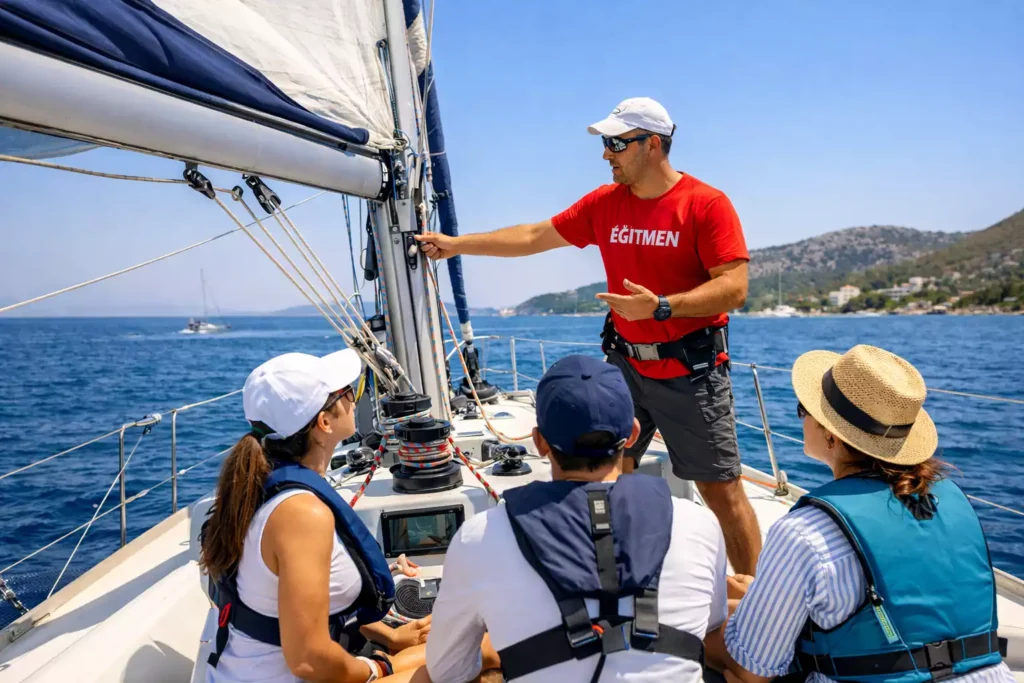
Some providers run day and 2-night, 3-day training programmes on a 12-metre Beneteau 393. Sea, fuel, marina and instructor costs change with the season, so confirm the current offer and what it covers before booking. Sailing Lessons in Bodrum options, look beyond the number of days: check how many people are on board and how many hours of daily practice you get.
| Programme type | Length and boat | Scope note |
|---|---|---|
| Day sailing lesson | 12-metre Beneteau 393, up to 6 people | Lunch sandwich, soft drinks, water, tea, coffee and instruction may be included |
| Programme 1 (Mon–Tue–Wed) | 12-metre boat, 2 nights 3 days, 3 double cabins, 2 bathrooms | Breakfast, lunch and dinner, soft drinks, water, tea, coffee and boat and instructor may be included |
| Programme 2 (Fri–Sat–Sun) | 12-metre boat, 2 nights 3 days, 3 double cabins, 2 bathrooms | Breakfast, lunch and dinner, soft drinks, water, tea, coffee and boat and instructor may be included |
What to look for in a training provider
Check the instructors’ certificates and sea experience, regular maintenance of boats and safety gear, participants per lesson and the balance of theory and practice. Discuss level suitability, certification and postponement terms in bad weather directly with the provider.
Day lessons or multi-day: the difference
Day lessons are good for getting a feel for the wind, setting and lowering sails and basic manoeuvres. Multi-day cabin programmes suit those who want to sleep aboard, learn the watch system, approach coves, practise anchoring and feel how the wind changes through the day.
Shared boats and private groups
Some Sailing Lessons in Bodrum programmes combine individual participants into small groups, while others offer private plans covering the whole boat for friends or families. Separating per-person and per-boat prices clearly at booking avoids surprise costs.
Sailing lessons in Bodrum: clubs, schools and training points
Below you can browse Bodrum sailing clubs, academies and training points by type and area. Where no current rating exists, none is shown; confirm the current programme, lesson hours and booking terms directly with each provider.
6 clubs and training points shown
Sailing lessons in Bodrum: centre and Kumbahçe
Club and training options on the Bodrum centre and Kumbahçe seafront.
B.B. Bodrumspor Sailing Branch
Sailing club Google rating to be confirmedA sailing and windsurfing branch on Atatürk Caddesi in Kumbahçe. The club runs sailing and water sports for different levels; confirm current training groups, enrolment periods and lesson hours directly with the club.
Bodrum Yelken Kulübü (Bodrum Sailing Club)
Sailing club Google rating to be confirmedA long-standing sailing club founded in 1967 under the Turkish Sailing Federation. Confirm the current season programme, open lesson calendar and enrolment terms for racing and training directly with the club.
Sailing lessons in Bodrum: Bitez and İslamhaneleri
Academy and sailing club options on the Bitez and İslamhaneleri line.
Beta Bodrum Sailing Academy
Sailing academy Google rating to be confirmedA sailing academy listed at an address in İslamhaneleri. Check by phone whether private or group training is running, boat capacity and opening hours before booking.
Era Bodrum Sailing Club
Academy and club Google rating to be confirmedA sailing club and course provider listed in Bitez and the centre. Confirm course programmes for different levels, boat types and start dates through current announcements and contact lines.
Bitez Mah., Çökertme Cad. No: 9 / Neyzen Tevfik Cd. 120/2, Bodrum
Sailing lessons in Bodrum: marina and Turgutreis line
Training and sailing points around the marina, yacht clubs and Turgutreis.
Bodrum Marina, Yacht Clubs and Yacht Companies
Marina and yacht services Confirm current programmesDay or multi-day sailing training and charter options can be found through yacht clubs and boat operators in the marina. Clarify boat features, instructor team and included services in advance.
Turgutreis Sailing Sports Club, Main Facility
Sailing facility Google rating to be confirmedA sailing club facility registered on the Turgutreis Fishing Harbour square. Ask the facility for current information on training and club activities in the western winds of the peninsula.
Turgutreis Mah., Balıkçı Barınağı Meydan No: 11, Turgutreis, Bodrum
About this list: These club, academy and marina options are compiled from listings; active groups, lesson hours and phone numbers can change, so confirm before applying. If you want a provider added, write to us.
How does sailing training in Bodrum work?
Sailing training is a theory and practice process that teaches you to control a sailing boat’s direction and speed safely using wind power. Programmes range from a few days to longer packages, depending on level and intensity.
- 1Basic theoryHow wind works, how sails are set and lowered, and the logic of manoeuvring by wind direction come first.
- 2Boat and equipmentThe parts of the training boat, sail types, ropes and safety gear are introduced.
- 3Practical lessonsWith an instructor you practise setting and lowering sails, trimming to wind angle, steering and turning at sea.
- 4Gaining experienceRepeating in different wind strengths and sea states builds decision-making and boat control.
- 5Safety and communicationHazard prevention, lifejackets and safety equipment, and crew communication are reinforced.
- 6Moving to advanced levelOnce basic sailing skills settle, you can move on to more advanced cruising or racing-focused training.
Wind, season and waters
When planning your Sailing Lessons in Bodrum experience on the Bodrum peninsula, consider wind that changes through the day, the difference between open sea and coves, and the season. Mornings are often calmer, with wind building in the afternoon.
- Learning setting: Early practice in sheltered coves helps you settle sail trim and steering.
- Wind and timing: Sailing on different wind angles lets you feel the balance of beam and broad reaches.
- Season and flexibility: In spring, summer and autumn the instructor updates departure times and routes with weather and sea reports.
Sail types, parts, terms and rules at sea
Knowing sailcloths, main boat parts, common terms and the basic rules covered in sailing lessons speeds up communication in class.
Common sail types and boat parts
- Dacron sail: A tough, long-lasting synthetic cloth, common on training and cruising boats.
- Nylon sail: Light and flexible, used in variable winds and racing.
- Mylar sail: A film-based laminate on polyester or nylon, found on performance sails.
- Spinnaker: A large sail set for winds from astern that adds drive and speed.
- Genoa and jib: Headsails that are trimmed to the wind to help balance and drive.
- Mainsail and jib: The mainsail is the basic sail on the mast; the jib sits ahead of it and complements it.
- Sheets and lines: Used to set and trim sails and keep control during manoeuvres.
Basic sailing terms
- Wind and wind direction: The airflow that drives the boat and where it comes from; angles are read relative to the bow.
- Bow and stern: The bow is the front of the boat and the stern is the back.
- Jib, mast, boom and rudder: The mast carries the sails, the boom holds the foot of the mainsail, the jib is the headsail and the rudder controls direction.
- Capsize, port and starboard: Rolling over is a capsize; looking forward from the stern, left is port and right is starboard.
- Trim and points of sail: Adjusting sails to the wind is called trim; points of sail describe the angle between the boat and the wind.
Basic rules of the road at sea (COLREGs summary)
- Assistance and collision avoidance (Rule 1): All vessels under way share a duty to help in danger and prevent collisions.
- Careful lookout and safe speed (Rules 5–6): Watch the surroundings, other vessels and sea conditions at all times by sight, hearing and available means.
- Risk and crossing rules (Rules 7–8, 12–14, 17, 19): Act early where there is risk of collision, give larger vessels room, follow priority and shallow-water rules; in an emergency the skipper takes any further action needed.
Basic sailing manoeuvres and principles
Handling a sailing boat in wind and waves combines basic manoeuvres with seamanship principles.
Main manoeuvres
- 1TackingTurning the bow through the wind to put the boat on a new wind angle.
- 2GybingTurning the stern through the wind so the sails swing to the other side; done with control to avoid sudden swings.
- 3BeatingA series of tacks in a zigzag to make progress against the wind.
- 4ReachingSmooth, balanced sailing with the wind from the side.
- 5RacingSailing focused on wind angle, tactics and timing to gain on rivals.
- 6Heaving toUsing wind and sails to slow the boat and hold it almost still.
- 7Man overboardReturning safely and under control to a person in the water.
Core principles of sailing
- Using the wind and wind angle: Sail angles are adjusted to wind speed and direction to keep the boat efficient.
- Performance and awareness: Keep sails and helm working together while watching the surroundings and weather.
- Tactics, safety and teamwork: Safety gear, following the rules and clear crew communication are the basis of good sailing.
Safety rules, nearby activities and access
Sailing Lessons in Bodrum programmes, it matters to follow safety rules, prepare for wind and sun and plan your way to the jetty or harbour.
Safety and preparation notes
- Lifejacket and deck safety: Follow the instructor, wear lifejacket and safety gear correctly and take care on wet or moving decks.
- Sun, wind and sea: Bring a hat, sunglasses, sunscreen, water and a light windproof layer.
- Confirm your programme: Before the day, confirm boat type, departure time, included refreshments and weather postponement rules.
Nearby activities and how to get there
Before or after a lesson you can walk around Bodrum centre, the marina and nearby coves, spend time at seaside venues and explore the bays. You can reach jetties and marinas by minibus, taxi or car; always confirm the jetty and time beforehand.
Sailing lessons in Bodrum: summary
This guide brings together programme information, club listings and basic seamanship. Before choosing, check each provider’s current calendar, boat set-up and booking terms.
Strong points: Hands-on learning in the Aegean, formats from beginner to advanced and both day and multi-day programmes.
Things to check: Fees and programmes differ between providers, current schedules need confirming and plans can change with wind and sea.
Frequently asked questions about sailing lessons in Bodrum
Can I start sailing lessons in Bodrum with no experience?
Yes. Bodrum sailing clubs and schools offer basic theory and practical lessons for beginners; check the level before your first booking.
How much do sailing lessons cost?
Fees vary with season, boat type and included services, so confirm the current price and scope with the provider.
What is the difference between a day lesson and a 2-night programme?
Day programmes focus on basic sailing and short practice, while 2-night, 3-day programmes add sleeping on board and longer sailing practice.
Where can you look for sailing lessons in Bodrum?
The list includes B.B. Bodrumspor Sailing Branch, Beta Bodrum Sailing Academy, Bodrum Marina and its yacht clubs, Bodrum Sailing Club, Era Bodrum Sailing Club and Turgutreis Sailing Sports Club; check active programmes directly.
How do theory and practical lessons progress?
First come wind principles, sail parts, terms and safety rules, then practice on board with an instructor: setting, lowering, trimming and manoeuvres.
What is the difference between Dacron, nylon and Mylar sails?
Dacron is tough and common on training and cruising boats, nylon is light and used in variable conditions, and Mylar is a film laminate for performance sails.
What do the spinnaker, genoa, mainsail and jib do?
The mainsail gives basic drive, genoa and jib support performance as headsails, and the spinnaker adds power on suitable wind angles.
When do you tack and gybe?
You tack by turning the bow through the wind, and gybe by turning the stern through it so the sails cross to the other side.
What should I bring to a lesson?
A hat, sunglasses and sunscreen, water, comfortable non-slip shoes and a light windproof layer.
Does the weather affect lessons?
Yes. Wind strength and sea state directly affect safety and the sailing plan, so times or departures may change.
How can a provider be listed?
If you run a sailing club, school or business in Bodrum, write to us through the Bodrumlu.com contact page with your current address, contact, programme and certificate details.
Note: Programme details can change; confirm before booking.