Bodrum HalicarnassusHalicarnassus, the harbour city of Caria: its name, Herodotus and Artemisia, Mausolus and the Mausoleum, Alexander’s siege, the knights and the remains you can still see, with a walking route
Bodrum Halicarnassus: the Carian harbour city of Herodotus and the Mausoleum, Alexander’s siege, the knights, and 5 stops you can still visit.
Today’s Bodrum stands on top of ancient Halicarnassus. This city produced Herodotus, was home to one of the Seven Wonders of the Ancient World and held out against Alexander the Great for a long time. This Bodrum Halicarnassus guide tells the city’s story period by period and lists the remains you can see in Bodrum today, with a short walking route.
- Region
- Ancient Caria
- Location today
- Bodrum town
- Famous monument
- The Mausoleum
- Famous citizen
- Herodotus
Search the Bodrum Halicarnassus remains
Bodrum Halicarnassus: where does the name come from?
The ancient name of the city is Halikarnassos, known in English as Halicarnassus and in Turkish as Halikarnas. The name “Bodrum” came much later and is linked to the knights’ castle. The old name lives on: Cevat Şakir Kabaağaçlı, who wrote about Bodrum, took his pen name “the Fisherman of Halicarnassus” from it. For the wider picture of the town today, see our About Bodrum guide.
Bodrum Halicarnassus history, period by period
- Carians and Leleges: In early times the peninsula was home to the Carians and Leleges, with small Lelegian towns such as Pedasa on the hills.
- A Dorian city: Halicarnassus was founded by Dorians and counted among the Dorian cities of the region; over time it blended with Carian culture.
- Herodotus and Artemisia I: In the 5th century BC the city was under Persian rule. Herodotus of Halicarnassus, who wrote about the Persian Wars, became known as “the father of history”; in the same period Queen Artemisia I commanded ships in the Persian fleet.
- Capital of Mausolus: In the 4th century BC the Carian satrap Mausolus moved his seat to Halicarnassus, resettled the people of nearby Lelegian towns here, surrounded the city with walls and filled it with monumental buildings.
- Alexander’s siege: During Alexander the Great’s campaign in Anatolia the city held out through a long siege; the area around the Myndos Gate saw heavy fighting.
- Hellenistic, Roman and Byzantine times: The city lived on but lost its earlier importance; the Mausoleum was damaged by earthquakes.
- The knights: In the 15th century the Knights of St John built the castle on the ancient city’s islet, using stones from the Mausoleum.
- Excavations: In the 19th century the sculptures and reliefs found in Charles Newton’s excavations were taken to the British Museum; work at the site continued in later years.
You can read more in the Halicarnassus article on Wikipedia.
The symbol of Bodrum Halicarnassus: the Mausoleum
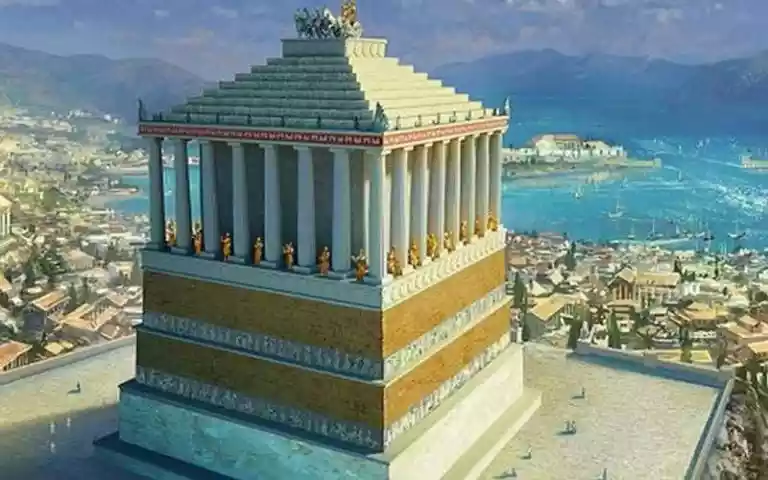
The monumental tomb built for Mausolus had a tall podium, a colonnade around it, a stepped pyramid roof and a four-horse chariot group on top. Famous Greek sculptors of the time worked on its decoration. It was counted among the Seven Wonders of the Ancient World and gave its name to the word “mausoleum”. It is one of two ancient wonders within today’s Turkey; the other is the Temple of Artemis at Ephesus.
- What is at the site? The area covered by the foundations, column and podium fragments and a small exhibition. To sense the monument’s scale, look first at how wide the foundations are.
- Where are the statues? The statues thought to be Mausolus and Artemisia, fragments of the horses and parts of the friezes are in the British Museum in London.
- Where are the stones? Some are in the walls of Bodrum Castle; you can pick out the ancient blocks as you walk around it.
Bodrum Halicarnassus: city plan, theatre and walls
Halicarnassus rose like an amphitheatre from the harbour up the slopes of Göktepe. The Mausoleum stood in the middle of the city, the theatre higher up the slope, and the walls ran in a line around the city from west to east. Today these Bodrum Halicarnassus remains are scattered among Bodrum’s streets; visiting them together shows how the ancient city spread from the harbour up the hill. For the peninsula’s landscape, see our Bodrum geography guide.
Bodrum Halicarnassus: the remains you can still see
The places below are grouped and listed alphabetically within each group. Ratings and review counts come from Google listings as of 25 November 2026; opening hours can change with the season.
5 places shown
Remains of the ancient city 3 places
In Bodrum town, among today’s streets.
- Ancient site★ 4,5 / 5 Google (4771)
Bodrum Ancient Theatre
Bodrum Halicarnassus · Remains of the ancient city
Halicarnassus’ theatre on the slope of Göktepe; the upper rows look over the castle and bay, and concerts are held in summer. Reviews say entry is free; cross the main road in front with care.
Address: Yeniköy, beside the D330 Phone: 0252 316 80 61 Hours: Daily 08:30–20:00
- Ancient site★ 4,2 / 5 Google (4244)
Mausoleum at Halicarnassus (Mausoleion)
Bodrum Halicarnassus · Remains of the ancient city
Site of the monumental tomb that was one of the Seven Wonders of the Ancient World. You can see the foundations, column fragments and a small exhibition; reviews mention how little remains but how much history the place carries.
Address: Tepecik, Turgut Reis Cd. No:93 Phone: 0252 316 12 19 Hours: Tue–Sun 08:30–17:00, closed Mondays
- Ancient site★ 4,2 / 5 Google (806)
Myndos Gate
Bodrum Halicarnassus · Remains of the ancient city
The monumental western gate of the walls built by Mausolus; remains of towers and the moat are visible. One of the places where the fiercest fighting took place during Alexander the Great’s siege. Open-air and free.
Address: Eskiçeşme, Bodrum Hours: Open daily
Castle and museum 1 place
On the ancient city’s islet.
- Museum and castle★ 4,6 / 5 Google (27469)
Bodrum Castle and Museum of Underwater Archaeology
Bodrum Halicarnassus · Castle and museum
The knights’ castle on the ancient city’s islet, built partly with stones taken from the Mausoleum. Its Museum of Underwater Archaeology displays shipwreck finds from the ancient sea trade that Halicarnassus was part of.
Address: Çarşı, Kale Cd. Phone: 0252 316 25 16 Hours: Daily 08:30–17:00
Nearby Lelegian town 1 place
In the hills north of the centre.
- Ancient site★ 4,3 / 5 Google (413)
Pedasa Ancient City
Bodrum Halicarnassus · Nearby Lelegian town
One of the Lelegian towns whose people Mausolus moved to Halicarnassus. A short path leads up to the acropolis on the hill; reviews highlight the view and the nature walk.
Address: Between Konacık and Torba, Bodrum
No place matches your search. Try another word.
A Bodrum Halicarnassus walking route
The Bodrum Halicarnassus remains can be seen on foot in half a day to a full day:
- Morning: Bodrum Castle and the Museum of Underwater Archaeology; look out for the ancient stones in the walls.
- Midday: Lunch in the bazaar, then the Mausoleum in Tepecik.
- Afternoon: Walk west to the Myndos Gate, then climb up to the Ancient Theatre.
- Extra day: Drive north to Pedasa to see the acropolis of the Lelegian town.
In summer, visit the open-air sites in the morning or late afternoon; the road up to the theatre is steep and crossing the main road in front of it needs care. More about the town and the peninsula is in our About Bodrum and Bodrum geography pages.
Bodrum Halicarnassus photos
 1 / 9
Bodrum Halicarnassus: frequently asked questions
Is Halicarnassus the old name of Bodrum?
Yes. The ancient city on the site of today’s Bodrum town was called Halicarnassus (Halikarnassos); in Turkish it is usually called Halikarnas.
Who was the Mausoleum at Halicarnassus built for?
It was built for Mausolus, the satrap of Caria. Work continued after his death under his wife Artemisia II. The word “mausoleum” comes from his name.
Can you still see the Mausoleum today?
The site in Tepecik has the foundations, column fragments and a small exhibition. The monument is no longer standing; some of its statues and reliefs are in the British Museum.
Was Herodotus from Halicarnassus?
Yes. Herodotus, often called “the father of history”, was born in Halicarnassus.
Are Halicarnassus and Bodrum Castle the same place?
No. Halicarnassus is the name of the ancient city; Bodrum Castle was built in the 15th century by the Knights of St John on the ancient city’s islet.
How long does a Bodrum Halicarnassus visit take?
The castle and museum take a few hours and the Mausoleum about an hour; with the Ancient Theatre and the Myndos Gate, plan for half a day to a full day.
Are there traces of Halicarnassus in Güvercinlik and Mumcular?
The ancient remains in this guide are in Bodrum town and at Pedasa to the north. There is no visitable Halicarnassus site in Güvercinlik or Mumcular on the eastern side of the peninsula.